A Quite brief History of Space Travel and Exploration
Humans have always looked up into the night sky and dreamed about space.
The development of ballistic missiles, first used by Germany toward the end of World War II, paved the way for the launch vehicles that would fuel a space race between the Soviet Union and the United States. The space race was then followed by an era of space cooperation, highlighted by the International Space Station.1
The First Satellite
Sputnik 1.
The first artificial satellite launched into space was Sputnik 1, launched by the Soviet Union on October 4, 1957. It was a spherical aluminum satellite with whip-like antennas and carried radio equipment to study the upper atmosphere and radio wave propagation.
Here's a more detailed look:
Purpose: Sputnik 1 was designed to be a simple, reliable satellite to study the Earth's atmosphere and radio signals.
Launch: It was launched from the Baikonur Cosmodrome in Kazakhstan, then part of the Soviet Union, as part of the International Geophysical Year.
Impact: The launch of Sputnik 1 marked the beginning of the Space Age and ushered in a new era of technological, military, and scientific advancements.
Success: Sputnik 1 successfully entered an elliptical low Earth orbit (LEO) and provided valuable data on atmospheric density and ionosphere characteristics.
Moon Landing
Landing on the moon: Apollo 12 launches for second moon landing Nov. 14, 1969.
"Landing a man on the Moon and returning him safely to Earth within a decade" was a national goal set by President John F. Kennedy in 1961. On July 20, 1969, astronaut Neil Armstrong took "one giant leap for mankind" as he stepped onto the Moon. Six Apollo missions were made to explore the Moon between 1969 and 1972.
Neil Armstrong stepped onto the surface of the Moon from the great Apollo 11 on 20 July 1969. As he did so, he spoke the famous words: "That's one small step for man, one giant leap for mankind."
A camera was able to transmit the moment to around 650 million people who were watching the Apollo mission on television.
They spent 21 hours on its surface, including a seven-hour sleep, before returning to Earth.
Armstrong was closely followed by fellow astronaut Buzz Aldrin, who described the Moon as "magnificent desolation".
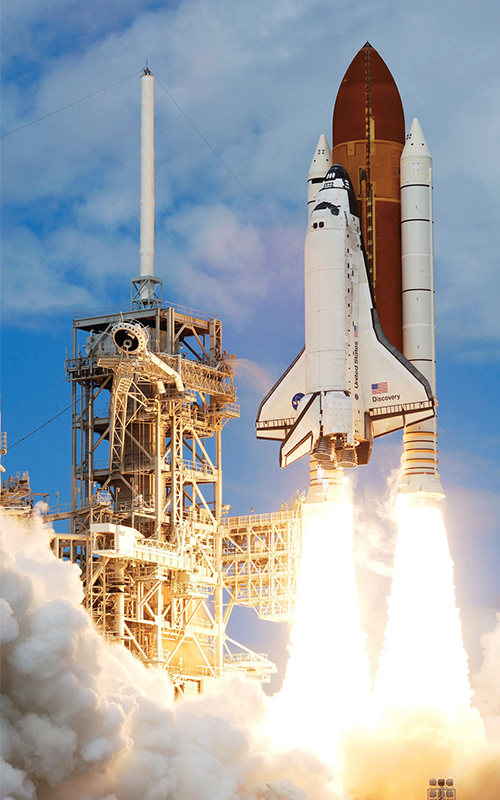
The Space Shuttles
Space Shuttle was the first reusable spacecraft to carry people into orbit; launch, recover, and repair satellites; conduct cutting-edge research; and help build the International Space Station.
In April 1981, the launch of the space shuttle Columbia ushered in a period of reliance on the reusable shuttle for most civilian and military space missions. Twenty-four successful shuttle launches fulfilled many scientific and military requirements until Jan. 28,1986, when just 73 seconds after liftoff, the space shuttle Challenger exploded. The crew of seven was killed, including Christa McAuliffe, a teacher from New Hampshire who would have been the first civilian in space.
The Columbia disaster was the second shuttle tragedy. On Feb. 1, 2003, the shuttle broke apart while reentering the Earth's atmosphere, killing all seven crew members. The disaster occurred over Texas, and only minutes before it was scheduled to land at the Kennedy Space Center. An investigation determined the catastrophe was caused by a piece of foam insulation that broke off the shuttle's propellant tank and damaged the edge of the shuttle's left wing. It was the second loss of a shuttle in 113 shuttle flights. After each of the disasters, space shuttle flight operations were suspended for more than two years.